
Prefabrication in brief
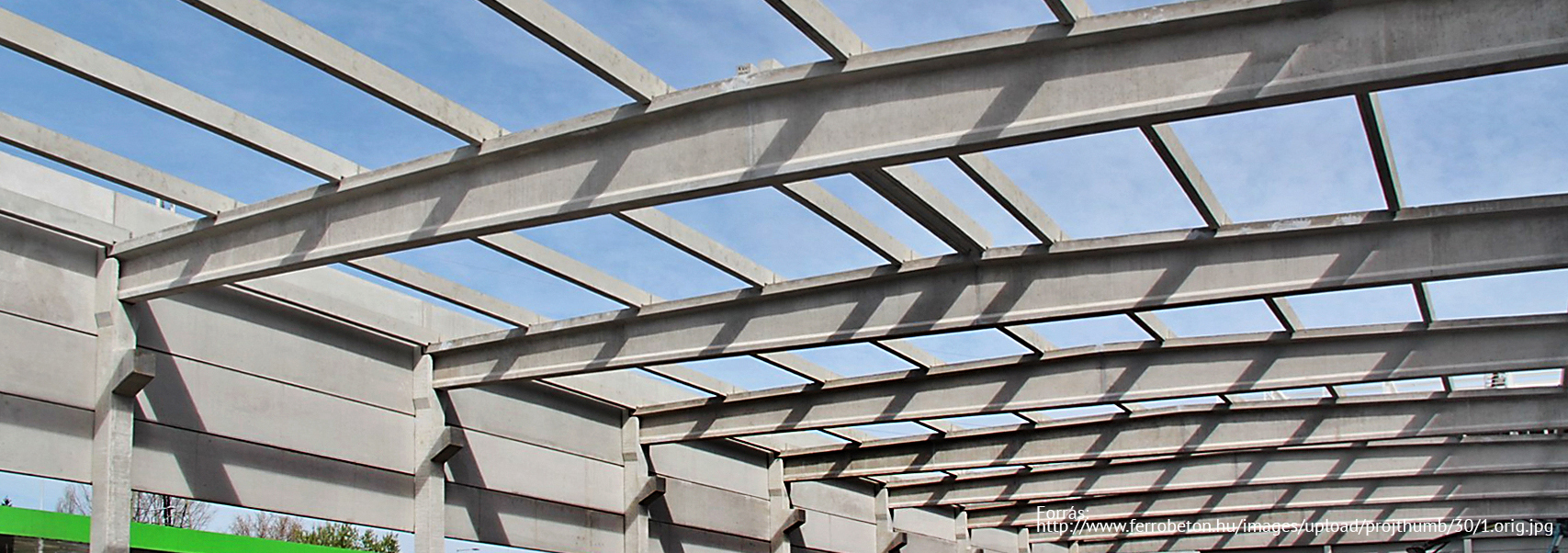
Why is prefabrication more advantageous? What needs to be considered during its construction? On-site prefabrication began to spread between 1950 and 1966. Its Hungarian pioneers were Mátrai Gyula (1950. IPARTERV), Mokk László (1952. 31. ÁÉV), and Gnädig Miklós (1953. IPARTERV). The objective of prefabrication includes creating standardized structures and a module-coordinated way of thinking to eliminate complex structural problems.
Advantages and Methods of Prefabrication
Initially, concrete and reinforced concrete construction was slow and seasonal, because winter concreting costs were very high. This problem can be eliminated with prefabrication.
While construction can generally only begin in mid-March due to weather conditions and can be continued at most until the first frosts, the end of October, prefabrication, by reducing on-site concreting, can add approximately 3 months – depending on the weather – to on-site construction.

3 Types of Prefabrication Methods:
Factory Prefabrication:
The main advantage of factory prefabrication is that the manufacturing process is mechanized, and even automated. It can be independent of weather conditions, and highly precise and high-quality elements can be produced. However, the size of the elements that can be manufactured is determined by the method of transport.
On-site Prefabrication:
On-site prefabrication, in contrast to factory prefabrication, allows for the construction of large elements. However, there is no skilled workforce, and the weather also plays a role in the production of elements.
On-site Auxiliary Plant:
The on-site auxiliary plant enjoys the advantages of both methods detailed above, but due to its cost, it is only feasible for larger investments.
Formwork Plan
Based on the foregoing, precise planning and execution are necessary. The formwork plan serves to simply calculate the tasks to be performed by breaking down the task to be performed into parts, geometric forms, on a copy of the design documentation, and marking them with a formwork number. A formwork plan must be prepared for those structures whose dimensions cannot be read directly from the plans.
- for more complex earthworks, shoring, sheet piling
- for foundations
- for rising walls, columns, partitions
- for external facade works
- for other works as required.

The Process of Prefabrication
Production Process for Reinforced Concrete Structures:
- preparatory operations for receiving aggregates, cement, reinforcing steel, etc.
- concrete production (using forced mixers),
- transport (on-site concrete transport),
- steel fixing, placement of fittings,
- assembly of molds, tensioning, placement of concrete mix,
- compaction (formwork vibrator, vibro table, rod vibrators)
- surface treatment (exposed concrete), concrete curing (e.g., steaming)
- demolding, stripping (surface cleaning and treatment of molds)
- finishing operations, post-treatment (watering)
- element marking
- possible repairs, storage
Summary:
Prefabrication can speed up construction time. However, the installation of elements requires precise execution and control, as there is very little room for on-site corrections.
Sources:
BME Department of Building Construction, Organization of Structure Assembly lecture notes
YBL lecture notes