
Construction cost estimation

The concept of a budget: a plan document prepared based on technical designs, usually for each structure, for the purpose of cost determination, which answers the questions of what, how much, and for how much. In addition to the technical description, this is what itemizes precisely the quality, technological, and other requirements also found in the technical designs. Essentially, it provides technical guidance, supplies quantitative data, and naturally determines the costs of the work.
The purpose of a budget can vary depending on the pricing method and the level of detail. In this article, I will detail two basic types and describe their practical implementation.
By level of detail:
The simplest is cost estimation, which – as its name suggests – is used for estimating costs for preliminary designs and for determining projected costs. For this, we use the Construction Industry Cost Estimation Guide. As an example, here is the cost estimation from my own thesis.
For the quantitative and qualitative determination of construction works, we prepare a detailed budget (detailed, itemized budget) based on the execution plans. Here we use a budgeting software. These are accompanied by a collection of norms (ÉMIR), which can be updated annually by purchase. (This is not mandatory, but some clients and tenders may require the use of the latest norm collection.) As another example, here is a budget for a facade of my own.
Of course, anyone who only wants to calculate some costs on a projected basis (!) can also use the following online calculator.
Budget item:
The basic element of a budget is an item.
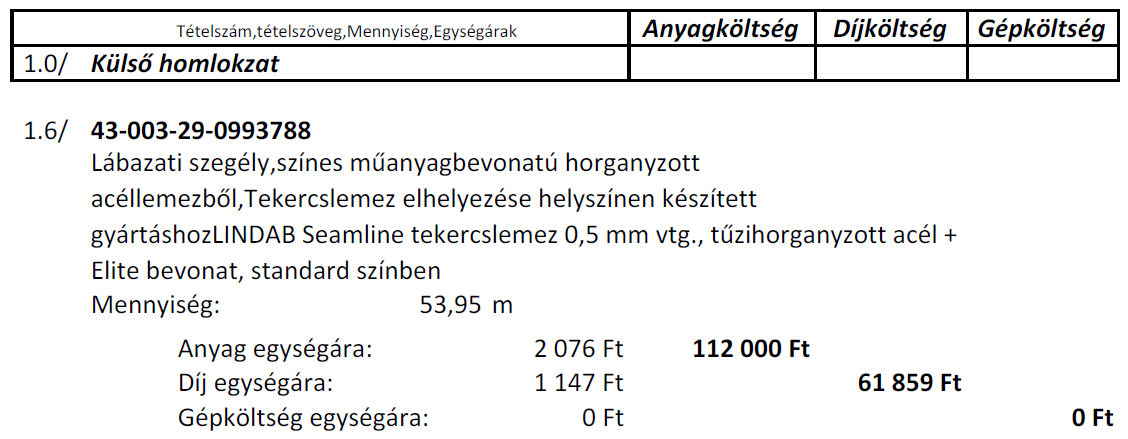
As you can see in the example above, an item consists of several parts. These are as follows:
- item number: the first two digits of this are the ÉMIR chapter number, and the rest are the item group number and the item number
- 1. Mixtures and temporary auxiliary structures
- 2. Substructure works
- 3. Building construction works
- 4. Specialized trades
- 5. Public utility and hydraulic engineering
- 6. Transportation construction
- 7. Electrical works
- 8. Building services
- technical specification text: this essentially contains the clarifications not included in the plans or technical description
- quantity: which can be calculated based on the plans
- unit prices: calculated based on norms (see below)
- costs: the product of the unit price and the quantity
Not among the items?!
It happens that the item we need is not included in the norm database. In such a case, we look for something similar and either modify the technical specification text or perhaps the norm times. We mark these with /M. According to the example above, this would be 43-003-29-0993788/M. It is important to mark these, because later we will know from this how we determined the cost of the given item.
Another case: we can't even find anything similar. In this case, we write a so-called "K-item" (különleges-tétel – special item). This is determined either according to a price quote or experience.
Relationship between norm times and costs.
The norm time shows how long a given process takes to complete with a given resource.
Based on the example, a trained assistant worker with an excavator digs 1 m³ of earth for a trench up to 2.0 meters deep in 0.69 hours.
This means that the labor cost/the cost of earth excavation (which is given in current databases, but is on average between HUF 2000-3500) is multiplied by the norm time. This gives the unit price of the labor.
labor cost x norm time = labor unit price
The procedure is similar for machine costs.
Overall summary:
In the overall summary, costs can be grouped by work types or building parts. This depends on the requirements, but machine, labor, and material costs are always listed and summed in separate columns.
Prices are ALWAYS WITHOUT VAT. The VAT amount is added to the total costs in the overall summary!
Summary:
Based on the above, it is perhaps understandable that appropriate detailed plans are necessary for preparing construction budgets and cost estimates, and that we need to know what processes the building consists of. Designers usually only do cost estimations. An itemized budget is much more detailed and accurate, and a separate company can even be commissioned for it. If you didn't understand something, feel free to look at my own budget and cost estimation, and you will figure out how it works.
Sources:
YBL lecture notes
own experience