
Logical relationships of scheduling
In the MPM network planning technique, logical relationships are used to define the interconnections between activities. This allows for calculating when activities can begin and how long they will take. Appropriate logical relationships are important for accurately and correctly determining time analysis.
Two graphical representations of the MPM (Metra Potential Method) network planning technique are widely known and used. One is the dynamic bar schedule (Gantt chart), and the other is the Cyclogram. For time analysis, we create logical relationships between activities, which can be different. It is important to know which of these relationships to apply, as this is essential for defining a good schedule.
(For clarity, I have replaced the time between relationships with 1-4 days in the image below)
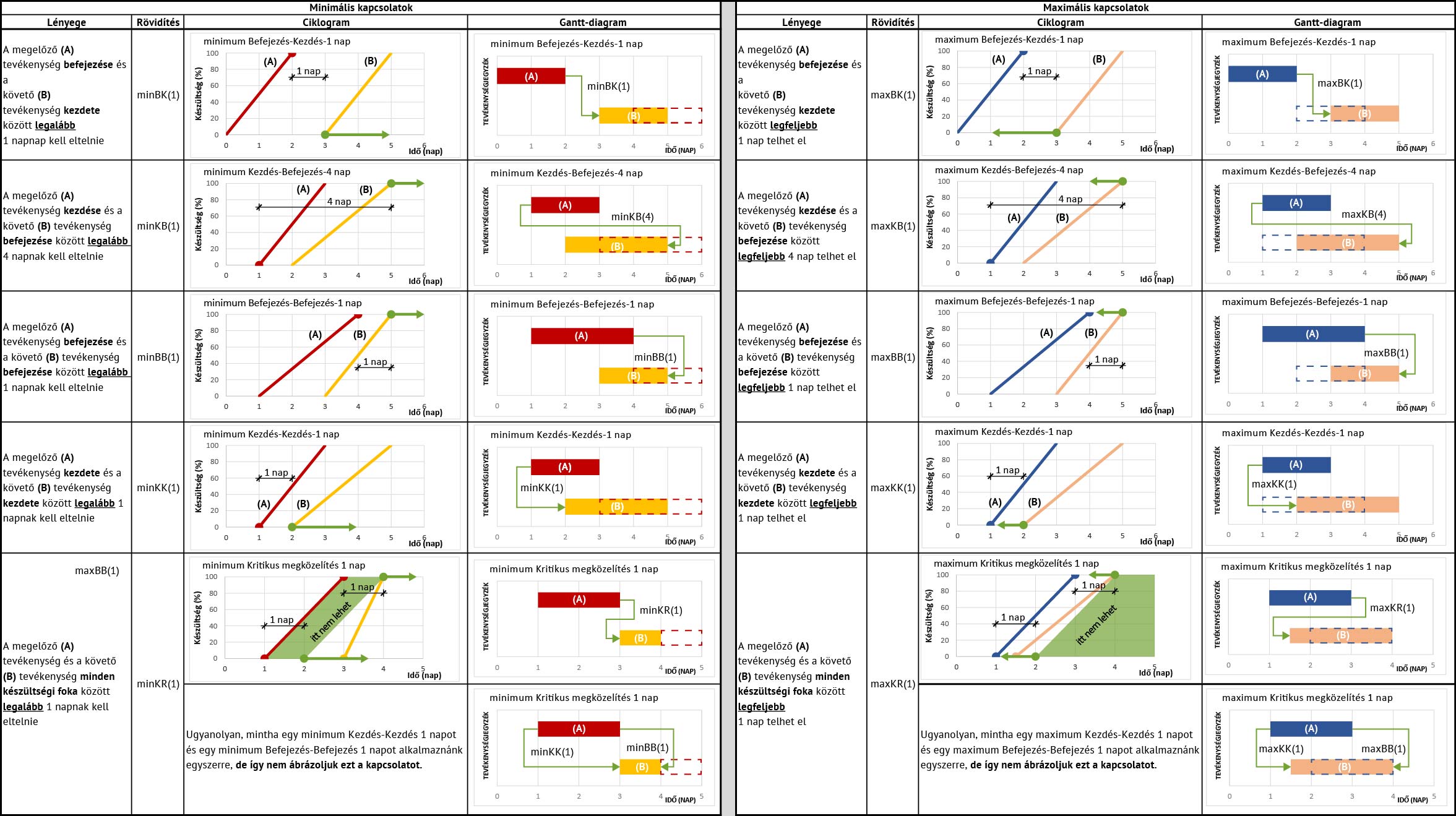
Summary of Logical Relationships
Simple logical relationships
Preliminarily, it can be stated about the relationship between minimum and maximum relationships that the difference lies in "at least" (more time than a given interval may pass) for minimum relationships, while for maximum relationships, it means "at most" (no more time than a given interval may pass).
Finish-Start relationship
This is the most frequently used logical relationship. Its essence is that the successor activity can only start after the preceding activity has finished.
- minimum Finish-Start (e.g., formwork removal can begin 4 days after concreting, but potentially later)
- maximum Finish-Start (e.g., trench shoring must begin at most 3 days after earth excavation to prevent collapse)
Start-Finish relationship
This logical relationship is not widely used, but it is very useful. Instead, we usually reverse the order of the two activities and use the Finish-Start relationship, but if we do not want to change the structure of our activity list, we can also apply this one. Its essence is that the successor activity must be finished after the preceding activity has started.
- minimum Start-Finish (e.g., it would be good to finish the thermal insulation of the external facades before starting the construction of partition walls)
- maximum Start-Finish (e.g., the thermal insulation of the attic floor must be finished before starting the installation of partition walls, because this prevents the walls from bulging due to additional load)
Here we must be careful that the preceding activity and the succeeding activity do not precede each other in time at the same level of completion. An example of this is starting to build the roof before the walls. This type of problem can only be seen when represented in a Cyclogram. The Gantt chart is unsuitable for this.
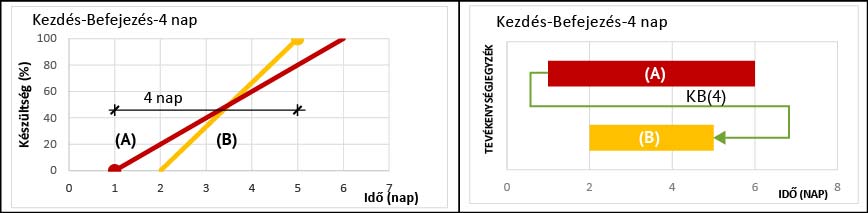
Start-Finish error
Finish-Finish relationship
Its essence is that the two processes must finish approximately at the same time, but it is not mandatory.
- minimum Finish-Finish (e.g., the completion of the two workfronts should preferably happen together, but it is not mandatory)
- maximum Finish-Finish (e.g., the laying of the interlocking paving must be finished at the latest by the time the topsoil is spread, so they are ready for handover)
Start-Start relationship
If our schedule contains few logical dependencies, this is a very useful logical relationship. In practice, the start of the preceding and succeeding activities can even begin simultaneously.
- minimum Start-Start (e.g., the dismantling of temporary structures can begin concurrently with the laying of the interlocking paving, but the paving work can also start later)
- maximum Start-Start (e.g., the technical handover must begin within one week of notifying the parties involved)
Critical approaches
Unlike simple logical relationships, here it is important that at least or at most a given amount of time must pass between the completion levels of the preceding and succeeding activities.

Critical Relationships
Minimum critical approach
At least a given amount of time must pass between every completion level of the preceding activity and the succeeding activity. We can also say that the start and end of the succeeding activity must be at a minimum time distance of 'Z' from every moment of the preceding activity. (e.g., preceding roof insulation can proceed in parallel with succeeding roof covering, but with a 2-day safety margin. So, two days must always be left between them, but potentially more.)
Maximum critical approach
At most a given amount of time may pass between every completion level of the preceding activity and the succeeding activity. This means that the start and end of the succeeding activity can be at a maximum time distance of 'Z' from every moment of the preceding activity. (e.g., similar to the previous shoring example, with the difference that the shoring must also be completed within 'Z' time after trench excavation)
Summary:
These many logical relationships may seem confusing. If you want to be sure, start filling your schedule with minimum Finish-Start relationships and apply maximum Finish-Start relationships where the technology requires it. The other relationships (especially Start-Start, Finish-Finish) should only be used to compress the schedule. Critical relationships should only be used when truly necessary.
Sources:
YBL lecture notes
own experience